Technical paper · SEXTANT
Measuring Six-Nines Residual Error for LLM Decisions Behind Independent Deterministic Checks.
A laboratory study on synthetic payment documents: how many wrong outputs of one language-model step are still accepted after deterministic checks against systems of record, and why that figure has to be counted rather than composed.
Version 1.0
- residual error
- deterministic checks
- zero-failure testing
- injected errors
- document extraction
- human review
- FlowX integration workflow
- pre-registration
One model, five checks, and a count
A language model extracts a payment record; deterministic checks against systems of record decide whether it is accepted. The question is how many wrong outputs still get accepted, and how one would know. The stream below is an illustrative mix; the counts are the paper’s.
Synthetic payment documents enter a pipeline. One language model extracts five fields: payee, IBAN, amount, currency and invoice reference. Four deterministic checks follow: format and IBAN checksum, which are self-contained, then the vendor registry and the order ledger, which are checked against systems of record. Anything a check cannot confirm is not accepted; the use case decides whether it is rejected, retried or reviewed. One kind of wrong output passes all four: the model returns another open invoice of the same vendor with the same amount. A fifth check, L5, does not accept an output when the vendor has more than one open order with that amount and currency, which stops it and also holds back some correct outputs. The counts: in Run C, 3,000,000 documents with Claude Haiku 5.5 and the checks as reference code, no wrong output was accepted, a one-sided 95% upper bound of 9.99 × 10⁻⁷ per output. On the FlowX platform, in a demo (non-production) environment, GPT-6 Luna behind the same five checks stopped every one of its 231,522 wrong outputs in 2,999,805 documents, 0 accepted, with verdicts equal to the reference code on every finished run. A second platform count on a 50,000-vendor world accepted no wrong output in 599,952 documents, a bound of 5.58 × 10⁻⁶ for vendors never seen: five nines, not six. All on synthetic documents, not production and not real invoices.
Core thesis
Deterministic checks around one language-model extraction step brought the share of outputs that are wrong and still accepted below one in a million on a synthetic payment task, but injected-error testing had understated that residual 5.3 times;a direct count found the blind spot, and a fifth check closed it.
The counts
What each check removes, counted on three million documents
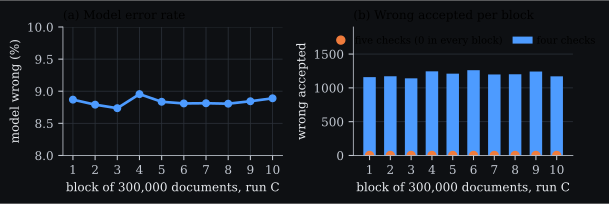
Run C: 3,000,000 fresh synthetic documents, Claude Haiku 5.5, and the checks as reference code. The same model outputs under acceptance rules added one layer at a time (an exploratory analysis, made after the data). The residual is the share of all outputs that are wrong and still accepted.
| Model alone | 8.8 × 10⁻² | 265,048 wrong accepted |
|---|---|---|
| + L1 format | 1.4 × 10⁻² | 43,006 wrong accepted |
| + L2 checksum | 4.6 × 10⁻³ | 13,824 wrong accepted |
| + L3 registry | 4.5 × 10⁻³ | 13,455 wrong accepted |
| + L4 ledger | 4.0 × 10⁻³ | 11,996 wrong accepted |
| + L5 uniqueness | ≤ 1.0 × 10⁻⁶ | 0 wrong accepted |
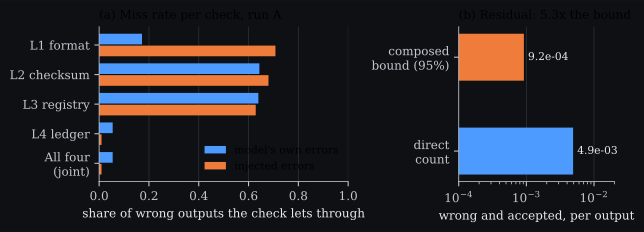
In the first run, every wrong output the four checks let through was of one kind: the model returned the reference of another open invoice of the same vendor that had the same amount. That record passes every check, because the IBAN, the payee, the amount and the currency are right and the reference is a real open order. L5 does not accept an output when the vendor that owns the IBAN has more than one open order with the record’s amount and currency. It was designed from the first run and then tested on fresh documents, with the criterion fixed in advance.
Outputs the checks cannot confirm are not accepted. That includes correct outputs the ledger cannot tell apart from another open invoice of the same vendor; the use case decides whether such an output is rejected, retried or reviewed.
Every run, side by side
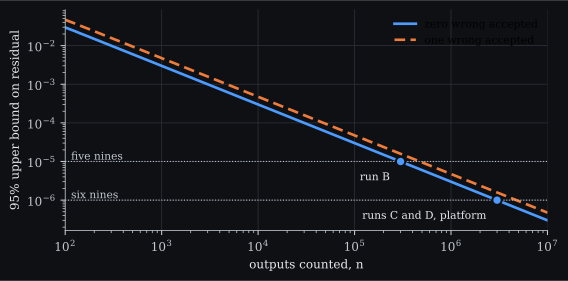
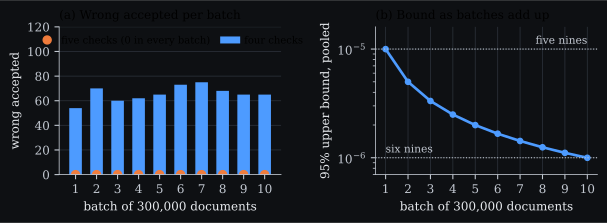
With five checks, no wrong output was accepted in Run B, Run C, Run D or either platform count. In the 2,000-vendor platform count, every one of the model’s 231,522 wrong outputs was stopped, 0 accepted. For vendors never seen, the bound is 5.58 per million on the platform (five nines, not six) and 1.78 per million in the lab.
Runs A, B and C used disjoint documents of one 2,000-vendor synthetic world; Run D a fresh world of 50,000 vendors built by the same rules. The two platform counts ran end to end as a FlowX integration workflow in a demo (non-production) environment: one on fresh documents of the Run C world (2,000 vendors), one on fresh documents of the Run D world (50,000 vendors). Plans, analysis code and pass criteria were committed before each run.
| Run A | Run B | Run C | Run D | Platform, 2,000 vendors | Platform, 50,000 vendors | |
|---|---|---|---|---|---|---|
| Model | Claude Haiku 5.5 | Claude Haiku 5.5 | Claude Haiku 5.5 | Claude Haiku 5.5 | GPT-6 Luna | GPT-6 Luna |
| Where the checks ran | reference code | reference code | reference code | reference code | FlowX workflow | FlowX workflow |
| Vendors | 2,000 | 2,000 | 2,000 | 50,000 | 2,000 | 50,000 |
| Documents with a result | 300,000 | 300,000 | 3,000,000 | 3,000,000 | 2,999,805 | 599,952 |
| Model wrong | 9.0% | 8.9% | 8.8% | 8.9% | 7.72% | 7.81% |
| Four checks: wrong accepted | 1,473 | 1,179 | 11,996 | 11,754 | 657 | 120 |
| Five checks: wrong accepted | (0) | 0 | 0 | 0 | 0 | 0 |
| Upper bound on the residual, 95% | 9.99 × 10⁻⁶ | 9.99 × 10⁻⁷ | 9.99 × 10⁻⁷ | 9.99 × 10⁻⁷ | 4.99 × 10⁻⁶ | |
| Bound for a new set of vendors | 1.7 to 2.3 × 10⁻⁵ | 1.78 × 10⁻⁶ | not estimated | 5.58 × 10⁻⁶ | ||
| Disagreements with the reference code | 0 | 0 |
Run A’s five-check figures are in brackets because L5 was designed on that run; they are not a test. The platform count on 2,000 vendors is a bound for the vendors of its world; statements about vendors not seen before rest on Run D (Claude Haiku 5.5 through the provider’s interface) and the platform count on 50,000 vendors (GPT-6 Luna, about 12 documents per vendor). Six nines for new vendors on the platform would need about 3.3 million documents. Of the 3,000,000 documents sent in the 2,000-vendor platform count, 42 started but did not finish and 153 produced no collected run; of the 600,000 in the 50,000-vendor count, 48 did not finish. They are reported, and none was counted as correct.
Abstract
No language model is accurate to six nines, yet process automation is often described with such figures. We study a narrower quantity that can be measured: the residual error of one model step wrapped in deterministic checks, defined as the probability that an output is wrong and accepted. On synthetic payment documents with truth known by construction, one model (Claude Haiku 5.5) was wrong on about 9% of documents. We report four results.
First, the cheap way to certify a low residual, multiplying the model’s error rate by the checks’ miss rate on injected errors, failed: it bounded the residual at 9.19 × 10⁻⁴ while a direct count on 300,000 documents found 4.91 × 10⁻³, 5.3 times higher. The model’s errors were not like injected errors. Every wrong output that passed the checks was of one kind, located exactly where the checks could not see.
Second, one further deterministic rule closed that gap, and a direct zero-failure test on fresh documents found no wrong accepted output in 300,000 and then in 3,000,000 documents, a one-sided 95% upper bound of 9.99 × 10⁻⁷ per output processed for the 2,000 vendors of the test world. Because errors cluster by vendor, that bound does not carry over to new vendors (about 2 × 10⁻⁵ for a new set). A repeat with the same model through the provider’s interface, on a fresh world of 50,000 vendors with about 60 documents each, again found no wrong accepted output in 3,000,000 documents (bound 9.99 × 10⁻⁷), and 1.78 × 10⁻⁶ for a new set of vendors from the same generator.
Third, the same checks ported to a FlowX integration workflow, run on the FlowX platform in a demo (non-production) environment with a second model (GPT-6 Luna), gave verdicts identical to the reference implementation on every one of 2,999,805 documents run end to end; every one of the model’s 231,522 wrong outputs was stopped, 0 accepted, a one-sided 95% bound of 9.99 × 10⁻⁷ per output processed on the 2,000-vendor world. A second pre-registered platform count, on the 50,000-vendor world, accepted no wrong output in 599,952 documents, a bound of 5.58 × 10⁻⁶ for a new set of vendors: five nines, not six. Outputs the checks could not verify were not accepted; the use case decides whether such an output is rejected, retried or reviewed.
Fourth, on 387 real invoices most of the model’s errors (69%) were of a kind injected errors never produce.
The bounds below 10⁻⁴ concern one synthetic task. They support no statement about production systems or real invoices, and the real-invoice results are percent-level. What they do support is a method and a warning: a residual error rate is a property of a model, a prompt, a set of checks and a document mix together, and it has to be counted, not composed.
Figures from the paper
1 more figures (Figures 5 to 5)
Part of the FlowX.AI paper series.
Each paper names its method and the evidence behind it, including where the method did not pay off.